
Counting Systems
Use weight to count parts, guide kitting, verify order contents, and reduce the manual errors that create waste, missing items, inventory shrinkage, and customer complaints.
Make Part Counts More Accurate, Repeatable & Visible
Manual counting can work when the order is simple and the operator knows every part. It starts to break down when assemblies have multiple components, hardware is pulled in bulk, or teams rely on paper manifests and memory to confirm what was picked.
Michelli helps customers use high-precision weighing, operator prompts, barcode scanning, and reporting tools to make counting and kitting more consistent. The goal is not to make the process more complicated — it is to make the right count easier to verify.
- Reduce Pull Errors
- Improve Kitting Accuracy
- Support Inventory Records
- Report QC Checks
Precision Counting
Use a known piece weight and a high-precision scale to count small parts faster and more reliably than hand counting.
Operator Guidance
Prompt the operator through the right part, count, and sequence so complex orders do not depend entirely on experience.
Barcode Selection
Use barcodes to select production runs, identify parts, confirm bins, and reduce the chance of pulling the wrong item.
Inventory Visibility
Capture manifest, inventory, and QC results so managers can see performance instead of waiting on paper records.
Inventory Counting vs. Guided Kitting
Counting systems can support broad inventory work or step-by-step kitting. The right path depends on whether the main problem is recording what was pulled, guiding the operator to pull the right parts, or verifying the finished package before it leaves.
Broad Stockroom & Manifest Work
Inventory Counting
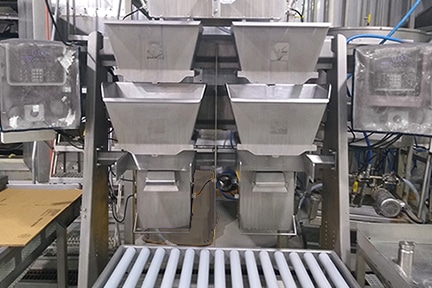
Inventory counting focuses on confirming quantities, supporting manifests, and helping teams pull or record parts more accurately. It is especially useful when hardware, small components, or bulk items are difficult to count by hand.
Count small parts by weight instead of hand counting every piece
Support order pulling, receiving, cycle counts, and manifest records
Reduce inventory shrinkage caused by over-pulling or bad records

Production Runs & Multi-Part Assemblies
Guided Kitting
Kitting guides an operator to pull specific parts for a production run or assembly. The system can help confirm the part, quantity, and sequence so missing items or extra material are caught before they become waste.
Prompt operators through complex multi-part assemblies
Use barcode scans to select production runs or verify specific parts
Improve final QC by checking that all required components are present
When Manual Counting Starts Creating Inventory Risk
Manual counting can work when part volumes are low, the items are easy to handle, and experienced operators know the job. But as quantities increase, parts get smaller, kits become more complex, and more people touch the workflow, small counting errors can turn into inventory gaps, missing components, wasted material, and customer-facing mistakes.
Counting systems bring a defined, weight-based process to repetitive counting and kitting work. They can help operators confirm quantities, follow manifests, verify kits, reduce hand-count errors, and create better records for inventory, QC, and production teams.
Michelli starts by looking at what is being counted, how parts are pulled, where errors show up, what records are needed, and whether a simple counting scale, dual-scale setup, barcode workflow, or more guided kitting system is the practical fit.
Warning Signs
Common Signs to Look For
Guesswork
Operators estimate counts or add extra parts because they are unsure of the target quantity.
Missing Components
Assembly, kitting, or final QC teams find parts missing later in the process.
Inventory Drift
Inventory is over-pulled, wasted, or difficult to reconcile after a production run.
Small Part Counts
Hardware, fasteners, components, or small parts are still counted by hand every time.
Paper Manifests
Stockroom, kitting, or fulfillment work depends on paper records and manual re-entry.
Limited Visibility
Managers lack timely data on pull accuracy, QC issues, or inventory usage trends.
Where Counting Systems Fit
Counting systems are useful anywhere the business needs to confirm quantities quickly, reduce hand-counting mistakes, or guide operators through a repeatable pull, pack, kit, or quality check.
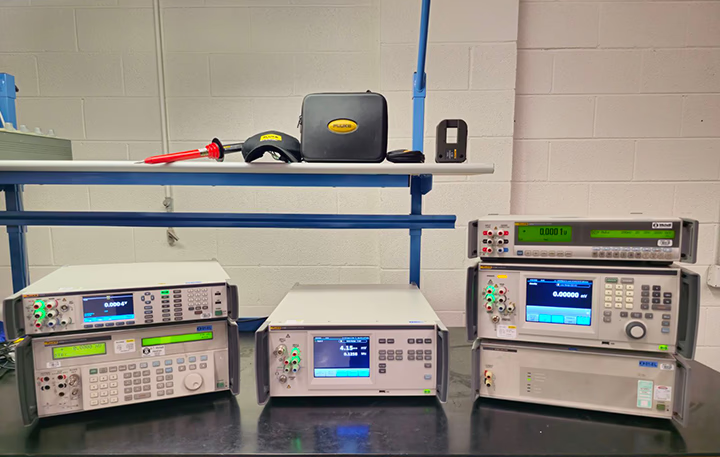
Small Parts & Hardware Counting
Count nuts, bolts, fasteners, fittings, and other small components by weight when manual counting slows teams down or creates errors.
Nuts, bolts, fasteners, fittings
High-speed vs. hand counting
Piece weight accuracy
Order Fulfillment & Packing
Verify that the right quantity or complete set of items has been pulled before an order is packed, staged, or shipped.
Pre-ship quantity verification
Reduce short shipments
Pack confirmation records
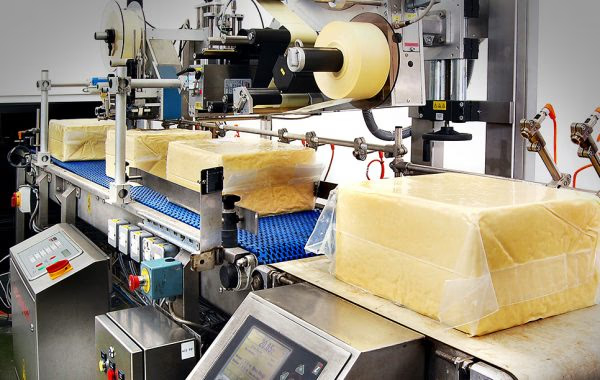
Production Kitting
Guide operators through the parts required for a production run so assemblies are complete and excess inventory is not pulled unnecessarily.
Multi-part assembly pulls
Operator step-by-step guidance
Reduce excess pull waste
Final QC Package Checks
Use weight as a fast confirmation that a multi-part package, kit, or assembly includes all required components before it leaves the facility.
End-of-line completeness check
Fast pass/fail by weight
QC record capture
Stockroom & Inventory Control
Improve the accuracy of pulls, returns, cycle counts, and manifest records by connecting the counting step to better data capture.
Cycle counts and receiving
Pull and return accuracy
Manifest and record support
Management Reporting
Send counting and QC results to management systems so teams can review performance, errors, productivity, and inventory trends.
Real-time QC visibility
Productivity and error tracking
Network and system export
SYSTEM COMPONENTS
What Goes Into a Counting System?
Michelli helps connect the scale, controller, barcode process, database, and reports to the way your team counts, kits, and verifies parts.
A strong counting system is built around the decision the operation needs to make: count it, pick it, kit it, verify it, record it, or report it. The components should fit that workflow without adding unnecessary steps for operators.
High-Precision Scale Base
A counting base or bench scale selected for the part size, piece weight, capacity, and accuracy needed.
Touchscreen Controller
A scale indicator, filling controller, batch controller, or PLC/PC-based path for targets, tolerances, outputs, and sequence logic.
Barcode Scanning
Select production runs, identify parts, confirm bins, or connect the count to a specific order or manifest.
Dual Bench Scale Setups
Use two scales when large, multi-part packages need more flexible verification or separate weighing stations.
Database & Manifest Records
Capture inventory, order, manifest, and QC data so the count becomes part of the business record.
Networked QC Reporting
Send QC checks and counting performance to management networks for oversight and continuous improvement.
BEYOND THE SCALE
Counting Data Is Inventory, Quality & Customer Experience Data
A counting scale does more than calculate quantity. When it is connected to the right workflow, it helps reduce material waste, speed up operator training, confirm package completeness, and give managers visibility into QC performance.
That data can support pull accuracy reviews, inventory reconciliation, customer complaint reduction, and better decisions about where errors are entering the kitting or fulfillment process.
What You Gain
Potential Business Value
Less Waste
Reduce material waste from over-pulling parts or building incomplete kits
Operator Efficiency
Improve accuracy while reducing training time for newer operators
Management Visibility
Give management real-time QC and inventory performance data
Customer Satisfaction
Protect customer satisfaction by reducing missing-item shipments
Inventory Accuracy
Better cycle count, manifest, and reconciliation records across operations
Room to Grow
Systems that can expand as part complexity and volume increase
Why Work With Michelli on Counting Systems?
Counting systems touch inventory, production, fulfillment, QC, and operator workflow. Michelli helps customers choose a practical system and supports it after the equipment is in place.
Application-First Planning
We look at the part size, count accuracy, operator role, packaging step, reporting need, and failure point before recommending a system.
Workflow-Based Configuration
Counting, kitting, barcode selection, dual scales, manifests, and reporting can be configured around the actual operation.
Data & Integration Support
Where needed, counting results can support inventory tracking, QC records, management visibility, and existing workflow systems.
Service After Install
Local service, calibration support, troubleshooting, and long-term support help keep the system accurate and useful over time.
Local Service. Nationwide Support.
Michelli supports customers through a service network built for demanding weighing and measurement environments.
Calibration Support
Michelli is ISO 9001 Registered with ISO 17025 Accredited calibration laboratories, with calibration support available based on equipment and scope.
COUNTING SYSTEMS
Need a Better Way to Count, Kit, or Verify Parts?
Loop Michelli in early. Tell us what is being counted, how operators pull parts today, where errors show up, and what records or reports the business needs to capture.
Helpful details to share:
- Part or item type
- Typical count range
- Inventory or kitting workflow
- Barcode or manifest needs
- QC verification point
- Reporting requirements
Request a Solution Review
Tell us about your counting or kitting application. A Michelli specialist can help identify the right next step.